
GitHub management panel for VS Code
 GeneralNoCodeDP
93af9ec0e8
Initial commit: GH-Hub VS Code extension v0.2.0
GeneralNoCodeDP
93af9ec0e8
Initial commit: GH-Hub VS Code extension v0.2.0
|
7 kuukautta sitten | |
|---|---|---|
| media | 7 kuukautta sitten | |
| .gitignore | 7 kuukautta sitten | |
| .vscodeignore | 7 kuukautta sitten | |
| README-draft.md | 7 kuukautta sitten | |
| ai.js | 7 kuukautta sitten | |
| extension.js | 7 kuukautta sitten | |
| gh.js | 7 kuukautta sitten | |
| package-lock.json | 7 kuukautta sitten | |
| package.json | 7 kuukautta sitten |
README-draft.md
VisualLogic.ai — The AI-Native Programming System
Where Language, Visual Graphs, and AI Agents are fully reversible.
Build production-ready applications from natural language — deterministically.
What is VisualLogic?
VisualLogic is a full-stack AI programming system built on VL (Visual Language) — a minimal, deterministic language designed specifically for AI code generation.
It is not a low-code tool. It is not a prompt wrapper. It is a complete programming system where:
- AI generates code with near-perfect accuracy, thanks to VL's low-entropy grammar
- Visual graphs provide a lossless, bidirectional view of every program
- Multi-agent workflows orchestrate the entire development lifecycle
VisualLogic is not a tool on top of code. VisualLogic is the programming system itself.
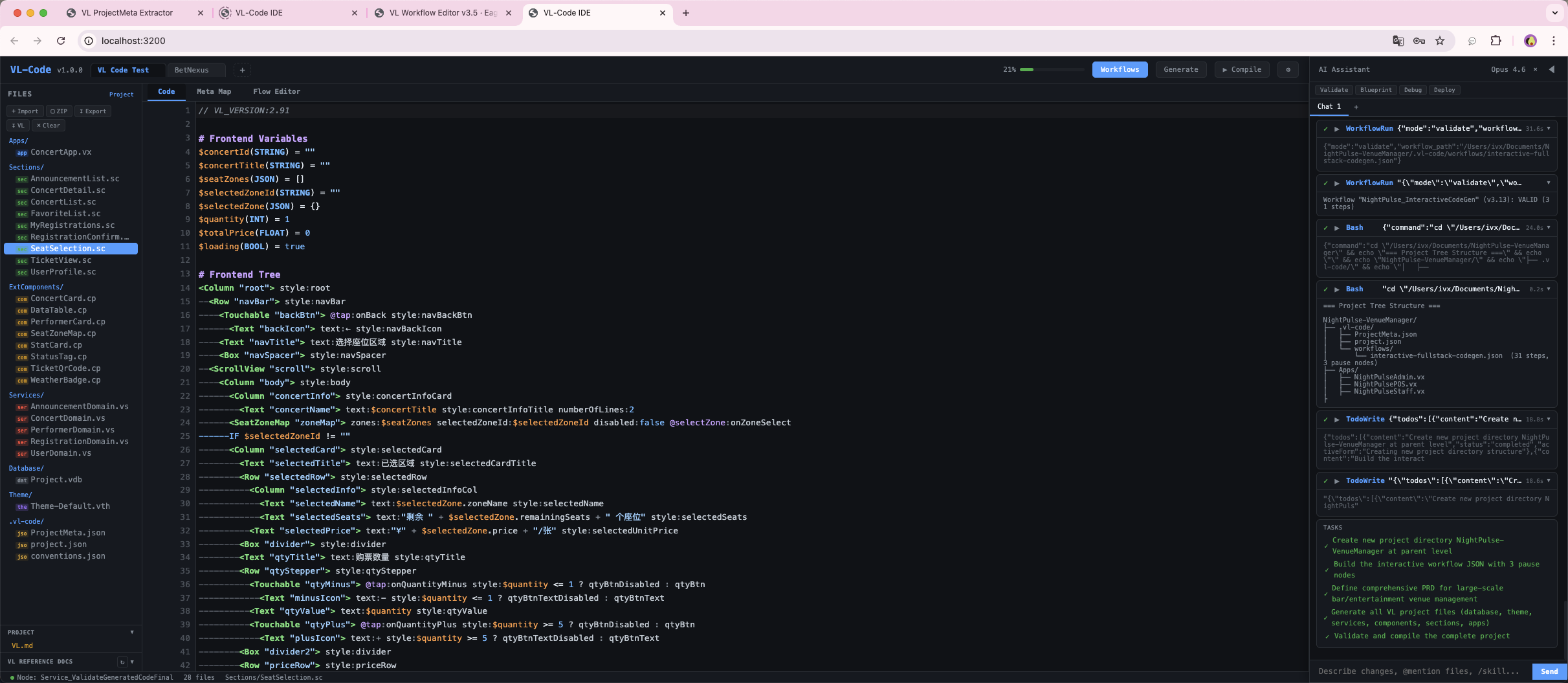
VL-Code Editor — AI-powered code editing with full VL syntax highlighting
The VL Language
VL (Visual Language) v2.91 is a declarative, component-oriented language covering the full stack through six file types:
| Extension | Purpose | Description |
|---|---|---|
.vx |
App | Navigation, routing, configuration |
.sc |
Section | UI tree, state, events, styles |
.cp |
Component | Reusable props-driven UI blocks |
.vs |
Service | API contracts, domain logic |
.vdb |
Database | Tables, columns, types, relations |
.vth |
Theme | Colors, typography, spacing tokens |
Why VL?
Traditional programming languages carry enormous entropy — formatting choices, import orderings, naming conventions, bracket styles. This makes AI generation unreliable and expensive.
VL eliminates this problem:
- Stable grammar — no formatting ambiguity, no hidden state
- Dash-based tree structure — clean hierarchy without brace/bracket noise
- Ultra-low token cost — compact representation means faster, cheaper AI generation
Massive parallelism — independent components enable multi-agent concurrent generation
APP MyApp
--title: My Application
--theme: Theme-Default

SECTION Dashboard
--$userCount(INT) = 0

--HANDLER onLoad()
----CALL UserDomain.getStats()
------ON SUCCESS
--------SET $userCount = result.total

--<Column "root">
----<StatCard "users"> label:"Total Users" value:$userCount
How It Works
Natural Language to Production App
Give VisualLogic a product requirement in plain language. An automated 8-agent pipeline handles everything:
| # | Agent | Output |
|---|---|---|
| 1 | Requirements Analyst | PRD document |
| 2 | Data Architect | Database schema (.vdb) |
| 3 | Service Designer | API contracts (.vs) |
| 4 | UI Architect | Screen/component breakdown |
| 5 | Component Builder | Reusable UI components (.cp) |
| 6 | Service Coder | Business logic (.vs) |
| 7 | Screen Builder | Screens with state & events (.sc) |
| 8 | App Assembler | App with routing (.vx) |
Stages 5-8 run in parallel using independent agents. The result: a fully compilable, deployable application.
Bidirectional Code-Graph Transformation
Every VL program has a direct, lossless mapping to a visual graph and back:
Natural Language
       |
   AI IDE (Agents + Workflows)
       |
   VL Source Files (.vx .sc .vs .vdb)
       |
   Visual IDE (Graph Editor)
       |
   VL Compiler
       |
   JS + Java / Node.js (Full Stack)
Edit in code. Switch to the visual canvas. Drag, connect, rearrange. Switch back. Nothing is lost. This is the "graphical escape hatch" that makes VisualLogic accessible to everyone — from senior engineers to people who've never written a line of code.
VL-Code: The AI IDE
VL-Code is the AI IDE for VisualLogic — a complete development environment where the LLM is not just an assistant, but the core execution engine.
Non-Linear Workflow Engine
Unlike simple plan-then-execute tools, VL-Code uses visual workflow DAGs (Directed Acyclic Graphs). Each node can:
- Call an LLM with targeted context
- Spawn sub-agents for parallel tasks
- Branch conditionally on results
- Loop over collections (files, components, services)
- Fork into parallel execution paths
These workflows are fully visual. You see every node, every data flow, every decision point. They drive every phase: development, testing, debugging, and deployment.
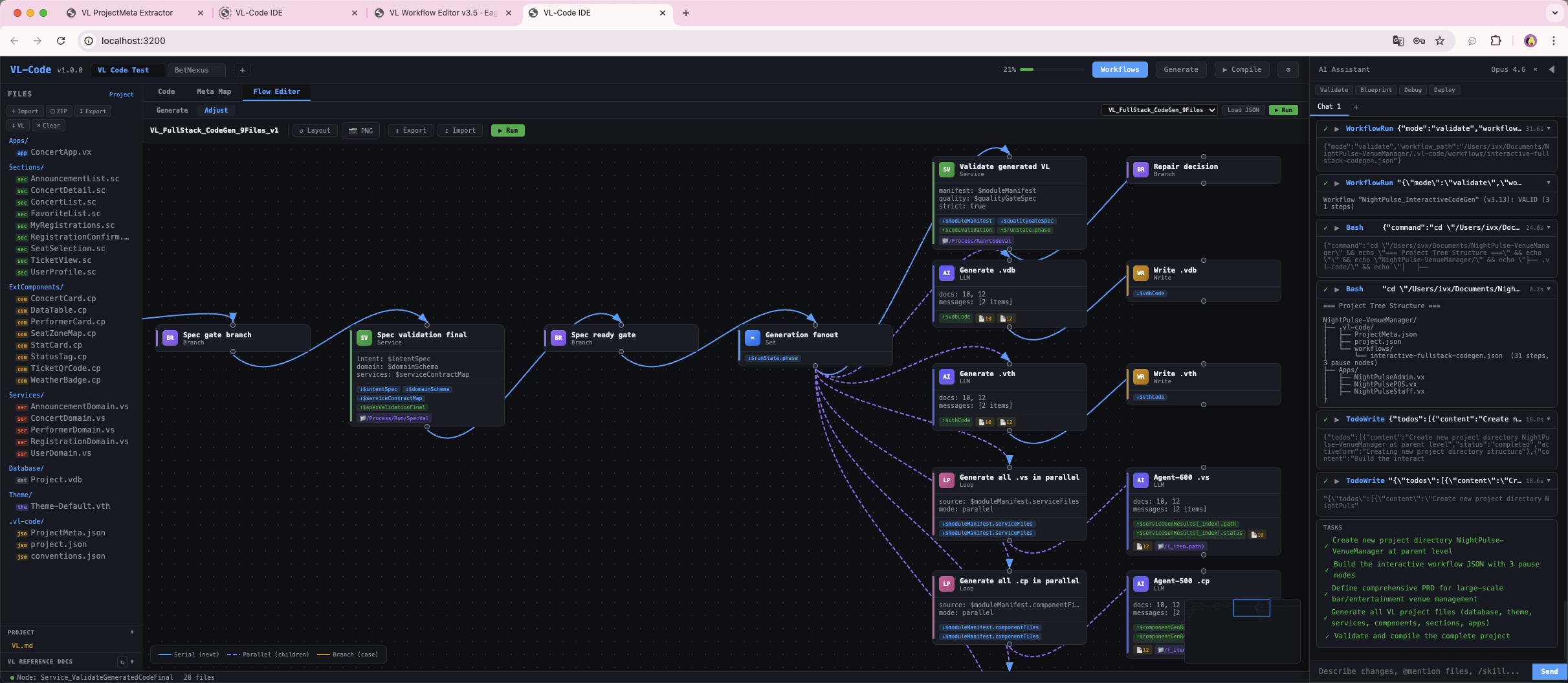
Flow Editor — Visual workflow DAG with multi-agent orchestration
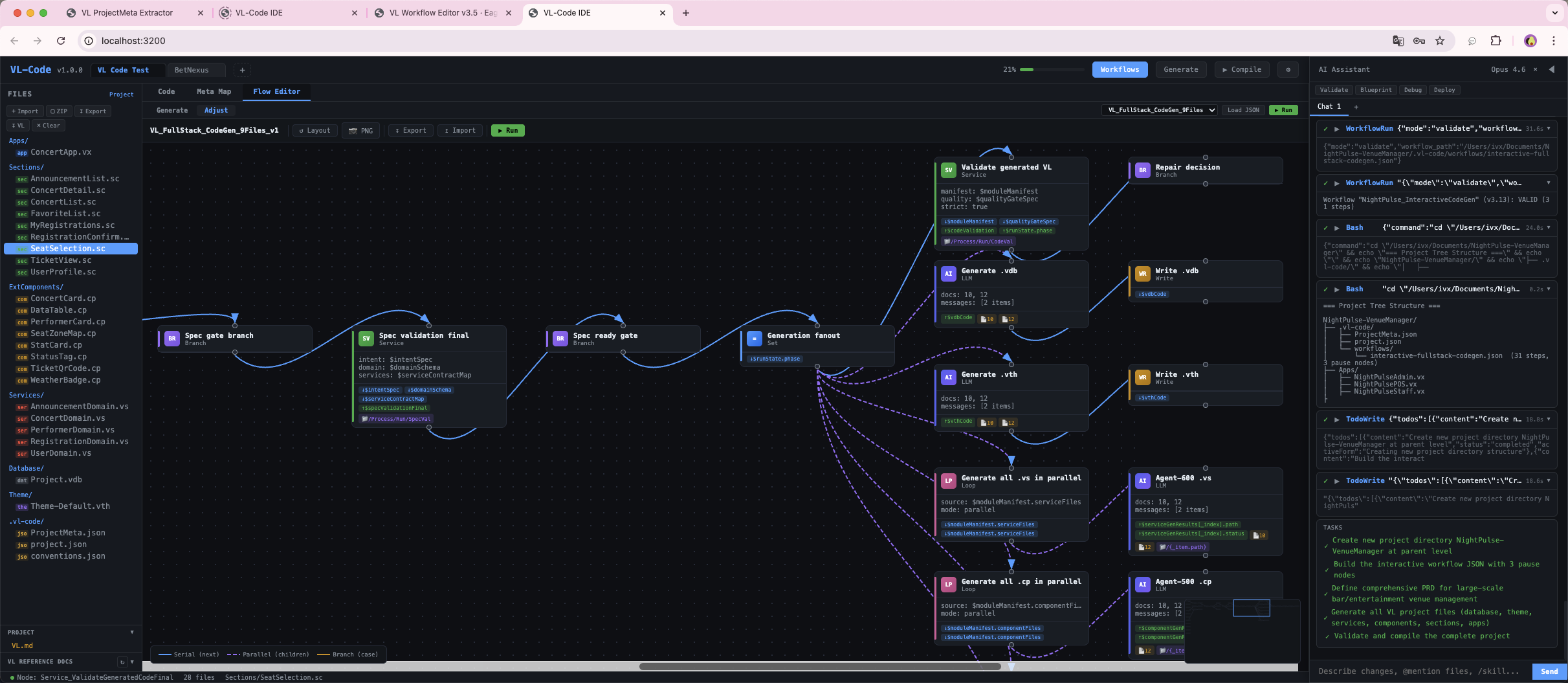
Meta Editor — Architecture overview and agent pipeline visualization
Semantic Intelligence
VL-Code doesn't just store files — it understands them:
- Real-time symbol index — every declaration, reference, and variable tracked across the project
- Dependency graph — automatic context loading based on file relationships
- Blueprint architecture — living PRD, service map, and data model injected into every AI interaction
- Auto-fix engine — syntax issues detected and repaired automatically
Developer Experience
- Go-to-definition across all VL file types
- Find all references for any symbol
- Context-aware autocomplete
- Impact analysis before renaming or removing
- Session persistence across restarts
- Multi-workspace project management
From Development to Production
VisualLogic applications aren't prototypes — they are production-ready:
- Develop — full IDE experience with AI generation and visual editing
- Compile — submit to the VL compiler, get instant preview URLs
- Test — automated browser-based verification via Playwright integration
- Debug — visual workflow tracing and impact analysis
- Deploy — publish to the VL Platform for production access
Open Source Strategy
| Layer | Status |
|---|---|
| VL Language Specification | Open |
| VL Grammar & Parser | Open |
| VL to Graph Mapping | Open |
| AI Optimization Patches | Closed |
| AI IDE (VL-Code) | Closed |
| Graphic IDE | Closed |
| Cloud Compiler | Closed |
The VL language specification and core parsing infrastructure are open, enabling the community to build tools, integrations, and extensions around the VL ecosystem.
Technical Stack
- Runtime: Node.js + Express with SSE streaming
- Editor: CodeMirror 5 (locally served, no CDN dependency)
- AI: Anthropic Claude with prompt caching (47K-token VL spec)
- Architecture: 4-segment prompt design for optimal token efficiency
- Integration: MCP (Model Context Protocol) compatible, extensible skills system
Who Is VisualLogic For?
| Audience | Value |
|---|---|
| AI-native developers | Leverage deterministic AI generation for rapid full-stack development |
| Non-technical creators | Build real applications through visual interfaces and natural language |
| Enterprise teams | Standardize on a structured, auditable, AI-native development platform |
| Researchers | Explore deterministic AI programming and language-graph reversibility |
| Platform builders | Build on open VL specifications for custom tooling and integrations |
Get Started
- Web Editor: editor.visuallogic.ai
- Community: Discord
- Tutorials: YouTube Playlist
The future of programming is deterministic AI + visual systems.
Build anything. Ship everything.